
How Nattokinase Works: The Science Behind the Enzyme
What Is nattokinase mechanism of action?
Understanding how nattokinase works is essential for anyone exploring natural cardiovascular support. Nattokinase is a serine protease enzyme originally discovered in natto, a traditional Japanese food made from fermented soybeans. In 1987, researcher Dr. Hiroyuki Sumi (Sumi et al., 1987) placed a sample of natto on an artificial blood clot in a petri dish -- and watched it dissolve the clot within 18 hours. That discovery launched decades of research into nattokinase as a natural fibrinolytic agent.
Related reading: Are the Dangers of High Cholesterol a Myth?
The enzyme is produced by the bacterium Bacillus subtilis var. natto during fermentation. Importantly, it's the bacteria -- not the soybean -- that creates nattokinase. This is why the enzyme can be produced using alternative substrates like chickpeas without any change in activity. This is central to understanding how nattokinase works at a biological level.
Nattokinase can be derived from soy-based or soy-free (chickpea) fermentation, with identical enzymatic activity regardless of substrate.
How Nattokinase Works: The Biological Mechanism
To understand nattokinase, you first need to understand the problem it addresses: excess fibrin.
The Fibrin Problem
Fibrin is a protein your body produces to form blood clots. When you cut your finger, fibrin creates a mesh that stops the bleeding -- that's healthy clotting. But your body also needs to remove clots once they've done their job. This cleanup process is called fibrinolysis.
Think of your cardiovascular system like a city's plumbing. Fibrin is the patching material used to fix leaks. But if old patches are never removed, the pipes gradually narrow. Over time, excess fibrin can contribute to:
- Reduced blood flow
- Increased blood viscosity (thicker blood)
- Higher risk of thrombosis (dangerous clot formation)
- Atherosclerotic plaque buildup
Nattokinase's Dual-Pathway Approach
This is where nattokinase gets interesting. Unlike most fibrinolytic agents that work through a single mechanism, nattokinase operates through two distinct pathways:
Nattokinase works by directly cleaving fibrin and by activating the body's own plasminogen into plasmin, providing dual-pathway fibrinolytic activity.
Pathway 1: Direct Fibrinolysis
Nattokinase can directly break down fibrin strands. It physically cleaves the protein bonds that hold a clot together. Imagine scissors cutting through a net -- nattokinase doesn't need your body's help to start dissolving fibrin.
Pathway 2: Plasminogen Activation
Your body has its own clot-dissolving system. The inactive protein plasminogen circulates in your blood, waiting to be converted into plasmin -- your body's primary fibrin-dissolving enzyme. Nattokinase boosts this conversion, essentially telling your body to ramp up its own cleanup crew.
This dual mechanism is significant because it means nattokinase both supplements and amplifies your body's natural fibrinolytic capacity.
Why Fibrin Specificity Matters
Unlike pharmaceutical thrombolytics that carry significant bleeding risk, nattokinase demonstrates fibrin specificity, meaning it preferentially breaks down fibrin clots without significantly affecting normal clotting factors.
Pharmaceutical thrombolytic drugs (like tPA, used in emergency stroke treatment) are powerful but blunt instruments. They can cause significant bleeding because they break down clotting factors broadly. Nattokinase shows preferential activity toward fibrin itself, which helps explain the strong safety profile observed in clinical trials. It targets the old, unwanted clots without dramatically disrupting your body's ability to form new clots when you actually need them.
The Science: Key Research Findings
Oral Absorption
One of the early skepticisms about nattokinase was whether an enzyme could survive digestion. A study by Kurosawa et al., 2015 published in Scientific Reports put this question to rest: Oral nattokinase is absorbed intact and retains fibrinolytic activity in the bloodstream.
Research published in Scientific Reports (2018) confirmed that orally administered nattokinase is absorbed intact through the intestinal tract and retains its fibrinolytic activity in the bloodstream.
Effects on Clotting Factors
Research by Hsia et al., 2009 showed that nattokinase supplementation reduced circulating levels of fibrinogen, factor VII, and factor VIII. These are upstream components of the clotting cascade, suggesting nattokinase has effects beyond just breaking down existing clots -- it may also reduce the tendency to form new ones.
Atherosclerotic Plaque
Perhaps the most striking clinical finding comes from Ren et al., 2017, who reported a 36.6% reduction in carotid artery plaque size after 26 weeks of nattokinase supplementation. While this is a single study and requires replication, it suggests nattokinase may affect not just acute clots but chronic arterial buildup.
Duration of Activity
Nattokinase has a functional half-life of approximately 8 to 12 hours in the body, which is substantially longer than many pharmaceutical fibrinolytic agents.
This relatively long functional half-life means that a single daily dose can provide sustained fibrinolytic support, which is consistent with the once-daily dosing used in most clinical trials.
Clinical Evidence Summary
EffectEvidence StrengthKey StudyFibrin dissolutionStrong (multiple studies)Kurosawa et al., 2015Blood pressure reductionModerate (RCT)Kim et al., 2008Clotting factor reductionModerateHsia et al., 2009Plaque reductionPreliminary (single study)Ren et al., 2017Lipid improvementEmergingMultiple small studies
It's important to be transparent about the evidence landscape: nattokinase research is promising but still maturing. The strongest evidence supports its fibrinolytic activity. Effects on blood pressure, plaque, and lipids are supported by smaller studies that need larger-scale replication.
Practical Implications
Understanding the mechanism helps explain why dosing matters so much. Enzymatic reactions are dose-dependent -- below a certain threshold, you simply don't generate enough fibrinolytic activity to produce measurable effects.
The clinically studied dosage of nattokinase is 10,800 fibrinolytic units (FU), significantly higher than the 2,000 FU found in most commercial supplements.
If you're considering nattokinase for cardiovascular support, the key takeaway from the mechanism research is:
- The enzyme works through validated biological pathways -- this isn't speculative.
- Dose determines whether those pathways are meaningfully activated -- underdosed products may not reach the activity threshold.
- It has a favorable safety profile at clinically studied doses, with the important caveat that it should not be combined with anticoagulant medications.
Getting the Right Dose
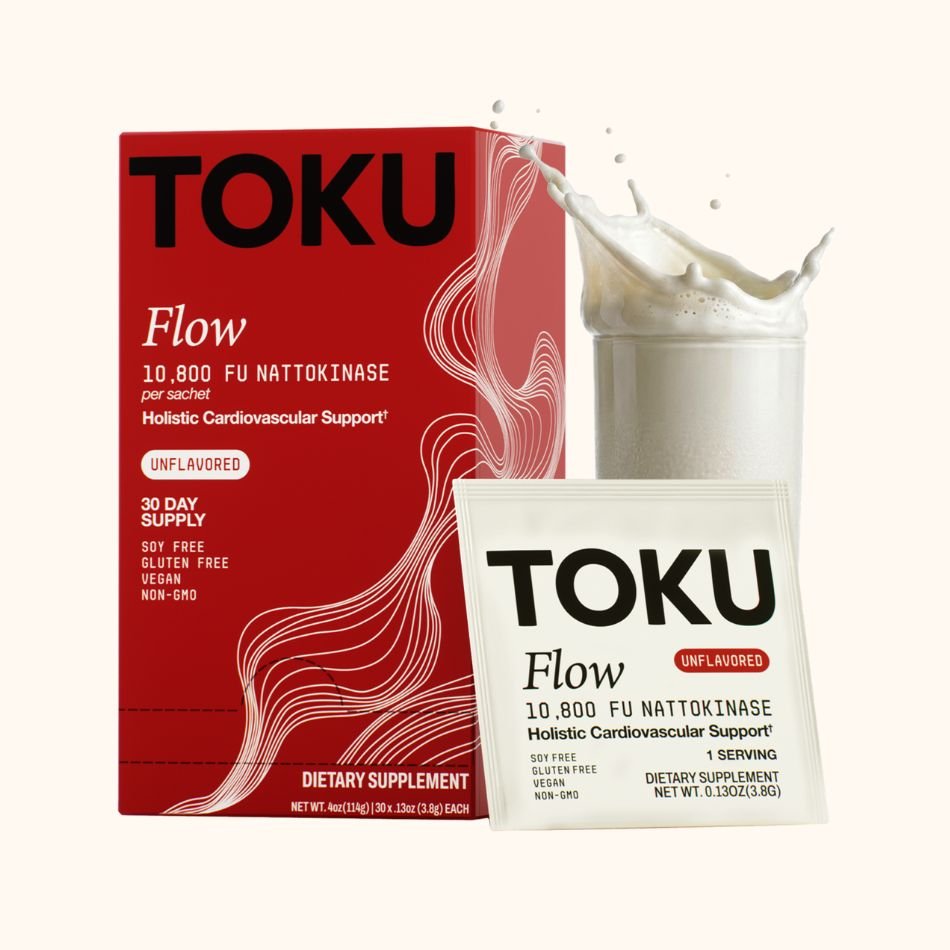
Toku is the first nattokinase supplement to offer 10,800 FU per serving, matching the dosage used in clinical research. Toku focuses on clinically meaningful doses rather than the standard underdosed formulations common in the supplement market.
Toku Flow | Nattokinase Supplement (10,800 FU)

$59.99
Our top rated nattokinase supplement, Toku Flow. A daily powdered supplement designed to promote clear, efficient blood flow and circulation, ensuring vital nutrients reach your heart and organs while supporting your body’s ability to clear metabolic waste for sustained vitality and overall wellness.